
Claude Code for marketing: what it does alone, and what needs an MCP server
By Jithin Palepu, founder of First100. Published 2026-09-27. Last updated 2026-09-27.
Claude Code is good at marketing work that happens on your laptop: research, drafts, data analysis and small tools. It cannot publish to your social accounts on a schedule, keep one brand memory across clients, read Google Search Console or count clicks on its own. For those, you connect an MCP server. This guide shows both halves, the exact setup, and a weekly routine.
Key takeaways
- Anthropic's own Growth Marketing team, a non-technical team of one, cut ad copy creation from 2 hours to 15 minutes with Claude Code.
- Claude Code requires a Pro, Max, Team, Enterprise or Console account; the free claude.ai plan does not include it.
- One command,
claude mcp add --transport http first100 https://firsthundred.app/api/mcp, gives Claude Code tools to schedule posts on X, LinkedIn, Threads and Bluesky. - Skills, commands, plugins and MCP servers are four different things: instructions, shortcuts, packages and live tools.
- This post was scored with First100's
review_blogtool before it went live.
What can Claude Code do for marketing on its own?
Claude Code is an agent that reads files, runs commands and writes code in your terminal. For marketing, that means four jobs it handles with no extra setup: research (reading pages and files you point it at), drafting (posts, emails, landing copy), analysis (CSV exports from ad platforms or analytics) and building small tools (scripts, plugins, reports). You do not need an integration for any of these. You need a folder, a clear prompt and the data.
The best public example comes from Anthropic itself. In the report How Anthropic teams use Claude Code (announced on Anthropic's blog on July 24, 2025), the Growth Marketing section describes the team this way:
"As a non-technical team of one, they use Claude Code to automate repetitive marketing tasks and create agentic workflows that would traditionally require significant engineering resources."
The report lists what they built. Each item is a pattern a founder can copy.
- Ad copy from a CSV. The workflow "processes CSV files containing hundreds of existing ads with performance metrics, identifies underperforming ads for iteration, and generates new variations that meet strict character limits (30 characters for headlines, 90 for descriptions)." It uses two sub-agents, one for headlines and one for descriptions.
- A Figma plugin. It "programmatically generates up to 100 ad variations by swapping headlines and descriptions, reducing what would take hours of copy-pasting to half a second per batch."
- An MCP server for Meta Ads. They "created an MCP server integrated with Meta Ads API to query campaign performance, spending data, and ad effectiveness directly within the Claude Desktop app."
- A memory system. It "logs hypotheses and experiments across ad iterations, allowing the system to pull previous test results into context when generating new variations."
The report's team impact page gives the numbers: "Ad copy creation reduced from 2 hours to 15 minutes" and a "10x increase in creative output."
Which marketing prompts work in Claude Code with no MCP server?
Start with jobs where the input is a file and the output is a file. Claude Code reads the file, does the work and saves the result next to it. None of the three prompts below needs an integration, an API key or a plugin. They work on a fresh install, in any folder, with the data you already have.
Turn customer words into positioning. Save ten support emails or call notes as text files in one folder. Then ask: "Read every file in this folder. List the exact phrases customers use for the problem, grouped by theme, with a count for each. Quote them word for word." You get your audience's language, not yours. That list feeds every post you write later.
Analyze an export. Download last month's analytics or ad report as a CSV. Ask: "Which five rows have the highest cost per click, and what do they share? Write the answer as a short table, then save a chart as a PNG." Claude Code writes a small script, runs it and shows you the file. This is the same pattern as Anthropic's ad workflow, on a smaller scale.
Build a small tool. Ask: "Write a script that adds UTM parameters to every link in a markdown file, with the source taken from the file name." It writes the script, tests it on a sample and tells you how to run it. You keep the tool.
The limit shows up when the output has to leave your machine on a schedule, or when the input lives behind someone else's login.
What can't Claude Code do without an MCP connection?
Look at that list again. Two of the four items are an MCP server and a memory system. The team had to build them, because Claude Code alone stops at the edge of your machine. It has no login to your X account. It keeps no queue of scheduled posts with retries when a platform times out. It keeps no record of which posts got clicks. Anthropic's own tip names the pattern: "Identify API-enabled repetitive tasks."
Here is where the gap sits for a founder doing marketing alone.
| Job | Claude Code alone | With an MCP server such as First100 |
|---|---|---|
| Write a post | Yes | Yes, with brand rules and past posts loaded |
| Publish at a set time | No social login, no post queue | save_drafts queues it; a server cron publishes it |
| Remember the brand | CLAUDE.md and auto memory, per project on your machine | Brand profile on the server, same in Claude Code, Codex, Cursor or claude.ai |
| Read Google Search Console | Only a CSV you export by hand | search_opportunities and indexation_check read live data |
| Count clicks on a post | No | Tracked links (/l/{code}) and get_funnel |
| Know what worked | Only if you paste metrics in | what_worked compares your own posts' engagement |
Claude Code does carry some memory. Its memory docs say "Each Claude Code session begins with a fresh context window," and that CLAUDE.md files and auto memory carry knowledge across sessions. That works well for code. It is local to one project on one machine, and it holds no post history or metrics.
You can build the missing pieces yourself, as Anthropic's team did. I built First100 so a solo founder does not have to.
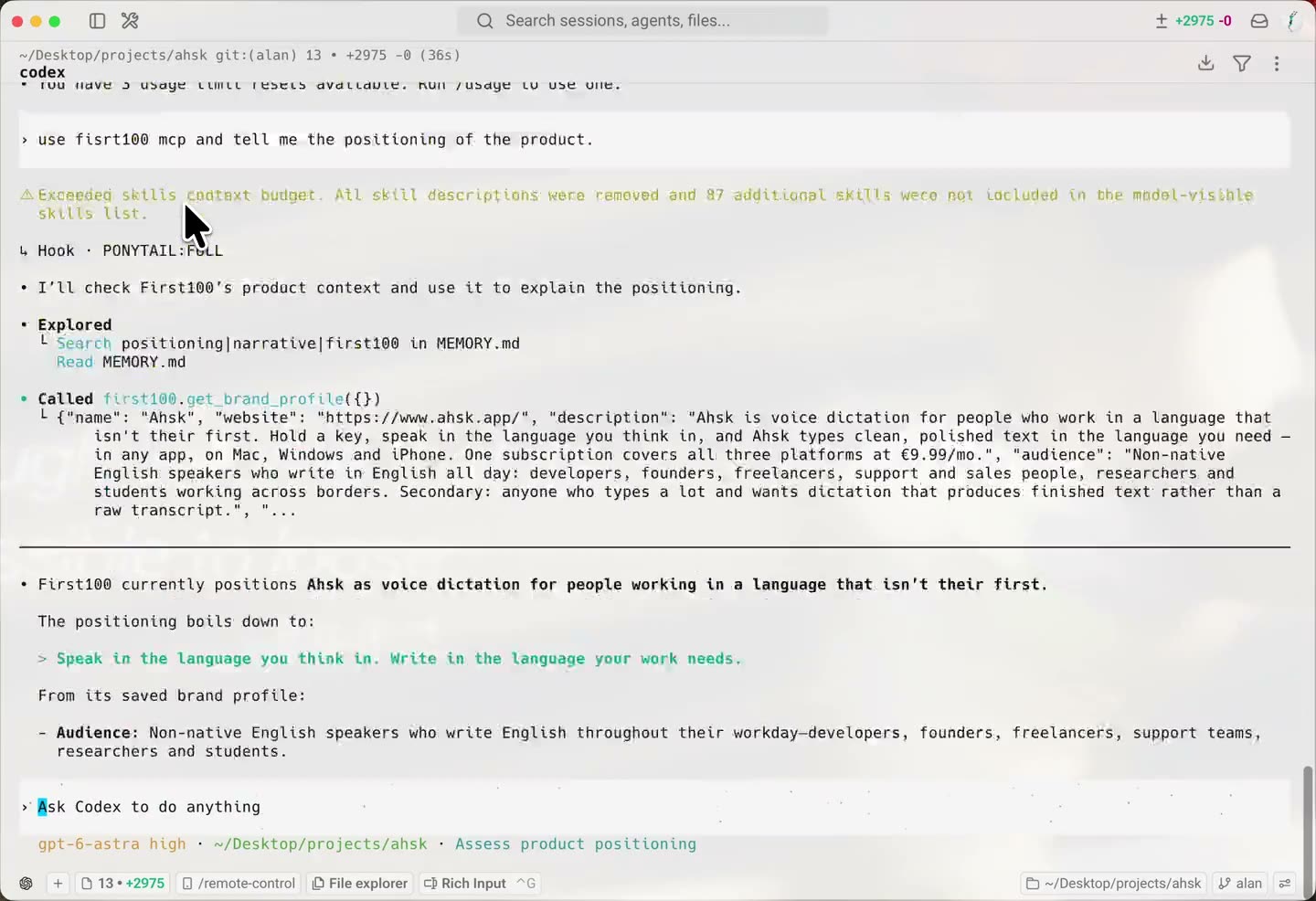
The screenshot above is Codex, not Claude Code, reading the same brand profile through get_brand_profile. That is the point of keeping the brand on the server: every agent you use starts from the same facts.
Do you need coding experience to use Claude Code for marketing?
No. Anthropic's Growth Marketing team is described in its own report as "non-technical." You need to open a terminal, paste an install command and type prompts in plain English. The setup docs include a terminal guide for people who have never opened one. There is also a desktop app if you prefer windows to a command line.
What helps is comfort with files. Claude Code works best when your material sits in a folder: a positioning doc, a list of customer quotes, last month's analytics export. Point it at the folder and ask. It reads before it writes.
The setup below is two commands. Everything after that is conversation.
Do you need Claude Pro or Max?
You need a paid account. The Claude Code setup page states: "Claude Code requires a Pro, Max, Team, Enterprise, or Console account. The free claude.ai plan does not include Claude Code access." You can also run it through Amazon Bedrock, Google Cloud or Microsoft Foundry.
On Claude's pricing page, Pro is $20 a month, or $17 a month billed annually ($204 over 12 months), and Max starts at $100 a month. The page says "Claude Code is included in all paid plans." For a weekly marketing routine of a few sessions, Pro is the place to start. Move up only if you hit usage limits.
First100 is a separate subscription. The week trial is $5 for 7 days with 20 posts. Starter is $39 a month with 300 posts; Pro is $59 a month with 600 posts. The pricing page lists the rest.
Skills, commands, plugins and MCP servers: what is the difference?
These four words describe different layers, and marketer guides often use them loosely. Here is each one, from Anthropic's docs.
| Term | What it is | Where it lives | Marketing example |
|---|---|---|---|
| Skill | A SKILL.md file of instructions Claude loads when relevant |
~/.claude/skills/ or a plugin |
"How we write LinkedIn posts" |
| Command | A skill or file you run by typing /name |
.claude/commands/ or a skill |
/weekly-plan |
| MCP server | A server that gives Claude live tools and data | Remote URL or local process | Posting, Search Console, click counts |
| Plugin | A package of skills, agents, hooks and MCP servers installed as one unit | A marketplace or a folder | The First100 plugin |
The skills docs say: "Custom commands have been merged into skills." A file at .claude/commands/deploy.md and a skill at .claude/skills/deploy/SKILL.md both create /deploy. The difference is that Claude can also load a skill on its own when its description matches your request.
The MCP docs define the other half: "MCP servers give Claude Code access to your tools, databases, and APIs." A skill tells Claude how to do something. An MCP server lets it actually do it.
The plugins docs describe a plugin as "a directory of skills, agents, hooks, MCP servers, or other components that Claude Code installs and loads as one unit." Use one when you want the whole setup in one install.
How do you connect First100 to Claude Code?
There are two ways. The first adds only the MCP server. The second installs the plugin, which adds the servers plus four skills. Either way, get an API key from the dashboard first (API key page), or use sign-in through /mcp with no key.
Option 1: the MCP server. Run this in your terminal, with your own key:
claude mcp add --transport http first100 https://firsthundred.app/api/mcp \
  --header "Authorization: Bearer f100_your_key"
Open Claude Code and type /mcp. First100 should show as connected. The Claude Code setup page has a 20-second video of the whole thing.
Option 2: the plugin. Inside Claude Code, run:
/plugin marketplace add jpalepu/first100-plugin
/plugin install first100@first100
Export FIRST100_API_KEY before you start Claude Code. The plugin configures three servers, first100-core, first100-seo and first100-outreach. It adds four skills: content-plan, blog-post, growth-review and morning-brief. The skills are thin on purpose. The rules and your account's numbers come from the server at run time.
Why three servers? Every tool definition costs tokens in every session. The domain endpoints load only the tools a job needs, and the default /api/mcp loads all of them.
What does a week of Claude Code marketing look like?
A week of founder marketing breaks into six or seven repeatable jobs. Each one maps to a plain-English prompt and one or two tools. You type the prompt; Claude Code picks the tool, reads the result and writes. First100 never writes the copy. It holds the brand, runs checks, schedules and measures. The agent does the writing.
| Weekly job | What you type in Claude Code | Tool that runs |
|---|---|---|
| See today's numbers and replies | "What should I do today?" | morning_brief prompt, reply_radar |
| Plan the week's posts | "Plan five posts for this week on X and LinkedIn" | plan_content prompt, get_content_context, suggest_slots |
| Check a draft | "Review this post before we save it" | review_post |
| Queue the posts | "Save these for the suggested slots" | save_drafts |
| Log a launch | "We shipped CSV export today" | log_update |
| Learn what worked | "Which of my posts did best, and why?" | what_worked, get_funnel |
| Write a blog post | "Write a post on claude code marketing" | write_blog prompt, research_blog, review_blog |
| Find search gaps | "Where am I close to page one on Google?" | search_opportunities |
review_post is deterministic. It checks the hook, links, filler and bait patterns with fixed rules. No model scores your post.
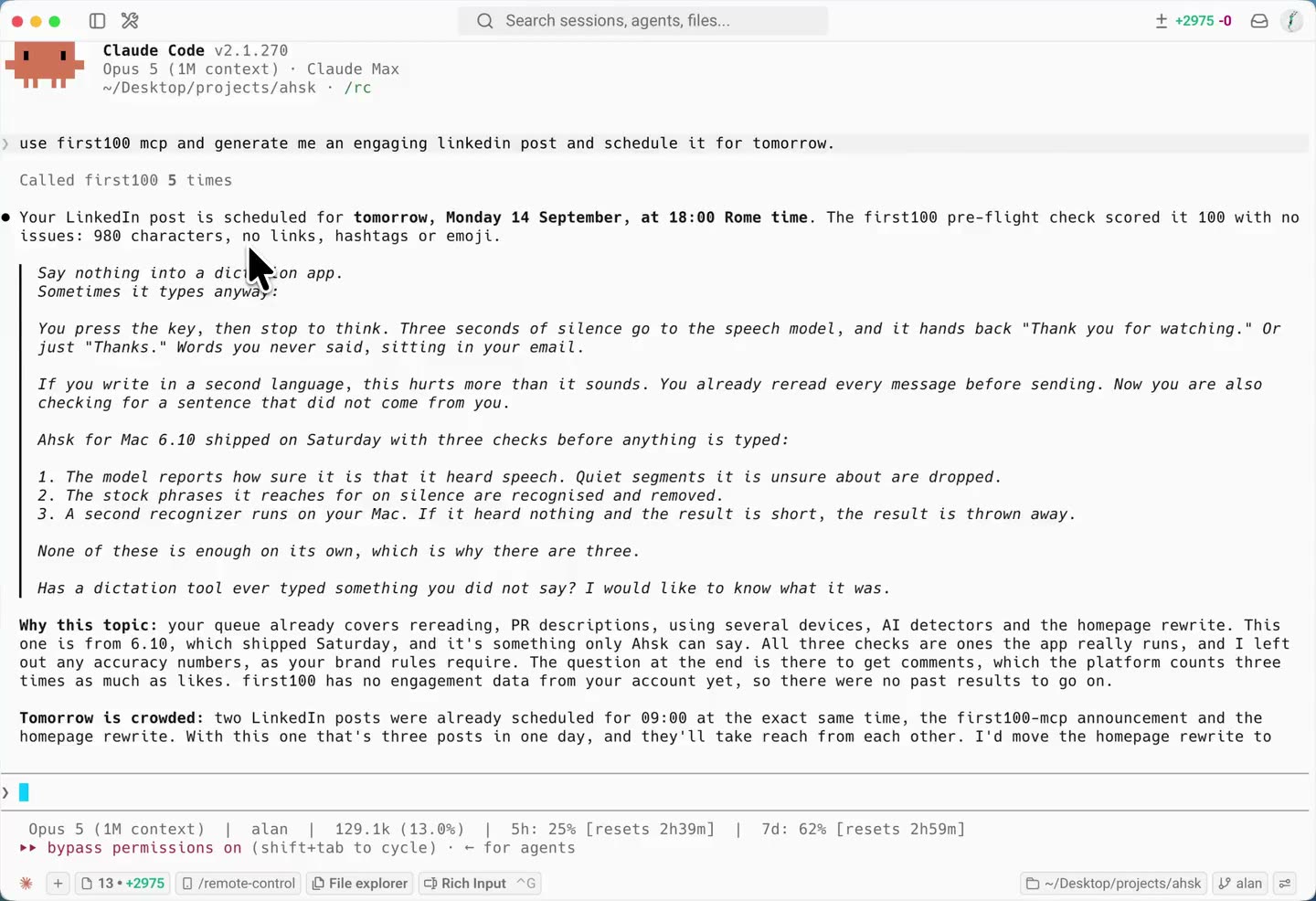
Above is a real session: one sentence in, five First100 calls, a LinkedIn post scheduled for the next day, and a note that two other posts were already queued for the same time.
What guardrails does the server add?
An agent with a publish button needs limits that do not depend on the agent remembering them. First100 enforces these on the server, for every client, whatever the prompt says. They exist because agents retry, loop and repeat themselves, and a social account pays for each mistake.
- No duplicates. Identical content on one platform within 24 hours is rejected.
- A daily cap. At most 25 posts per platform per day.
- Retries that do not double-post. A failed publish is retried at 5, 10 and 20 minutes. A post can only be claimed by one run.
- No automated engagement. First100 drafts replies for you to post. It never replies, DMs or follows on your behalf.
- Fresh facts. When you mention a launch,
log_updaterecords it.get_content_contextreturns updates from the last 30 days and warns when the brand profile is older than 30 days.
Search Console answers are cached for 12 hours, so a second question in the same morning comes back from the cache.
The weekly routine, step by step
The routine below is a suggested order, with most of the work on Monday. Each step is one prompt. The one-time setup comes first: connecting accounts, the brand profile and the watchlist, all covered in the first-week guide.
- Every morning: run the morning brief. Type "morning brief." The
morning_briefprompt pulls your numbers, the replies worth making in the next hour and the one post to publish. You post every reply yourself. First100 drafts; it never replies, DMs or follows for you. - Monday: plan the week. Type "plan this week's content." The
plan_contentprompt loads your brand, recent product updates, past posts and what the numbers say. Claude Code writes one post per slot. - Monday: review every draft. Ask Claude Code to run
review_poston each one and apply the fixes until the verdict is ready. - Monday: queue them.
save_draftsstores the posts. Auto-publish is on by default, so they publish at their slot times through the server cron. Turn it off in the brand profile if you want to approve each one. - Friday: check what worked.
what_workedcompares posts with a pattern against posts without it. It needs 5 settled posts (48 hours old) before it reports a finding, and it prints sample sizes. Small numbers stay small. - Once a week or two: write one blog post. The
write_blogprompt runsresearch_blogfor the brief and targets. Claude Code writes the draft in markdown.review_blogscores it until the verdict is ready.
Steps 1 to 5 run on the core server. Step 6 runs on the SEO server.
How was this post made?
This post went through step 6 of the routine. The brief came from research_blog on the keyword "claude code marketing." It found that the ranking pages show marketers building custom skills and tools, but none had tables and few had dates. That gap set the angle: a practical version with tables, dated sources and exact commands.
I then wrote the draft with Claude Code and ran it through review_blog. The tool scores structure and evidence: an answer-first opening, question headings, sourced data points, outbound links, tables, steps, an FAQ, a byline and dates. It flags AI filler phrases and passive voice. It gave a list of fixes, I applied them, and I re-ran it until the verdict was "ready."
Every quote from Anthropic in this post was checked against the source page on the publish date. Claims I could not check were cut.
FAQ
Is Claude Code good for marketing?
Yes, for research, drafting, analysis and building small tools. Anthropic's own Growth Marketing team cut ad copy creation from 2 hours to 15 minutes with it. It needs an MCP server to publish, schedule, keep shared brand memory or read live analytics.
Do I need to know how to code to use Claude Code for marketing?
No. Anthropic describes its Growth Marketing team as a non-technical team of one. You need to paste an install command and type prompts in plain English. Claude Code writes and runs any code the task needs.
Which Claude plan do I need for Claude Code?
A Pro, Max, Team, Enterprise or Console account. The free claude.ai plan does not include Claude Code. Pro costs $20 a month on Claude's pricing page, and Anthropic states Claude Code is included in all paid plans.
What is the difference between a Claude Code skill and an MCP server?
A skill is a SKILL.md file of instructions that tells Claude how to do a task. An MCP server gives Claude live tools and data, such as posting to X or reading Search Console. A plugin can package both.
Can Claude Code post to social media automatically?
Not by itself. It has no login to your social accounts and no queue of scheduled posts. With First100 connected, save_drafts queues posts for X, LinkedIn, Threads and Bluesky, and a server cron publishes them at their slot times.
Does First100 write the posts?
No. The agent writes every word. First100 holds the brand profile, runs deterministic checks such as review_post, schedules, publishes and measures clicks. There is no text generation in the server.
Set it up in the next ten minutes
Start with the Claude Code setup page: one claude mcp add command and /mcp to confirm. Then follow Your first week, which lists the setup steps in order; the dashboard's Get started page ticks them off from your real account state. If you build alone, the indie hackers page shows how the same setup fits a one-person company. Your first prompt on Monday: "morning brief."