
AI agent for marketing: the solo founder's version
By Jithin Palepu, founder of First100. Published 2026-09-27. Last updated 2026-09-27.
An AI agent for marketing is an agent you already use, such as Claude Code, Codex, Cursor or ChatGPT, connected to tools that let it act. The agent writes, researches and reasons on its own. It cannot publish at 9:00 tomorrow, remember your brand next week, read your Search Console or see which post brought clicks. Those jobs need tools, usually over MCP.
Key takeaways
- Social Media Examiner's 2026 survey of 681 marketers found only 11% have autonomous AI agents in their regular workflow, and 24% are experimenting.
- Gartner predicts 40% of enterprise applications will include task-specific AI agents by the end of 2026, up from less than 5% in 2025.
- A general agent covers writing and reasoning; publishing, memory, first-party data and measurement need an API, and MCP is the standard way to plug those in.
- In our 2026-09-24 benchmark of 10 real tasks, a guided writing method lifted a mid-tier model from 4.5 to 6.5 out of 10 and cut its invented claims from 19 to 6.
- X's automation rules forbid automated replies based on keyword searches alone, so an agent should draft replies and a human should post them.
What is an AI agent for marketing, if you are one person?
For a solo founder, an AI agent for marketing is not a new platform. It is the coding or chat agent you already pay for, given hands. The model already drafts a launch post, summarises a competitor page and argues about positioning. What it lacks is a way to act on the outside world and a memory that survives the session. Give it those through tools and it can run most of your weekly marketing from one conversation.
The pages that rank for this term are written for enterprise buyers. They describe agent platforms with orchestration layers, governance and seat pricing. That is a real market. Gartner, in an August 2025 press release, predicted that 40% of enterprise applications will include task-specific agents by the end of 2026.
A founder with one product does not need an orchestration layer. You need the agent you trust to post on schedule, recall what you shipped, and tell you what worked. The rest of this article splits the work into what the agent does well alone and what it needs a tool for.
How many marketers actually use AI agents today?
Fewer than the vendor pages suggest. Social Media Examiner's 2026 AI Marketing Industry Report surveyed 681 marketers and asked, for the first time, about agents that operate autonomously. Only 11% have them in their regular workflow and 24% are experimenting. Another 44% plan to adopt them. Only 13% have no plans, and 8% are not familiar with agents at all.
Two more numbers from the same report stand out. "Using AI agents" is the top AI topic marketers want to learn about, chosen by 74%. And the gap between segments is real: 31% of B2B marketers are experimenting with agents against 17% of B2C.
So most marketers are still at the planning stage. That matches what I see with founders. They use an agent every day to write code. Then they open four social dashboards by hand to post about it.
Which marketing jobs can an agent do alone?
A general agent can do any job whose output is text, a decision or an analysis of material you hand it. It cannot do a job that needs a credential, a clock, persistent memory or data that lives behind someone else's login. The table below sorts the common solo-founder marketing jobs by that line. The third column names what has to exist for the agent to finish the job.
| Marketing job | Agent alone? | What it needs | Example request |
|---|---|---|---|
| Draft a post or thread | Yes | Nothing; better with brand facts | "Write three hooks for the launch." |
| Research a competitor's public pages | Mostly | Web fetch or web search | "What changed on their pricing page?" |
| Remember tone, audience and banned topics | No | A stored brand profile it can read | "Use my usual voice." |
| Publish at 09:00 next Tuesday | No | Platform OAuth plus a scheduler that runs when your laptop is shut | "Schedule this for Tuesday morning." |
| Read Google Search Console | No | An OAuth grant to the Search Console API | "Which queries are close to page one?" |
| Know which post brought clicks | No | Tracked links and stored post metrics | "What worked last month?" |
| Find live threads to join | Partly | Search APIs for Hacker News, Bluesky, X | "Who is asking about this problem today?" |
| Send cold email | No | Your SMTP mailbox, throttling, an opt-out line | "Email these ten shops." |
| Reply, like, follow or DM | Should not | A human | "Draft a reply; I will post it." |
The pattern is simple. Writing and reasoning sit on the model's side. Credentials, time, memory and measurement sit on the tool side. Every "No" in the middle column is a gap a tool has to fill.
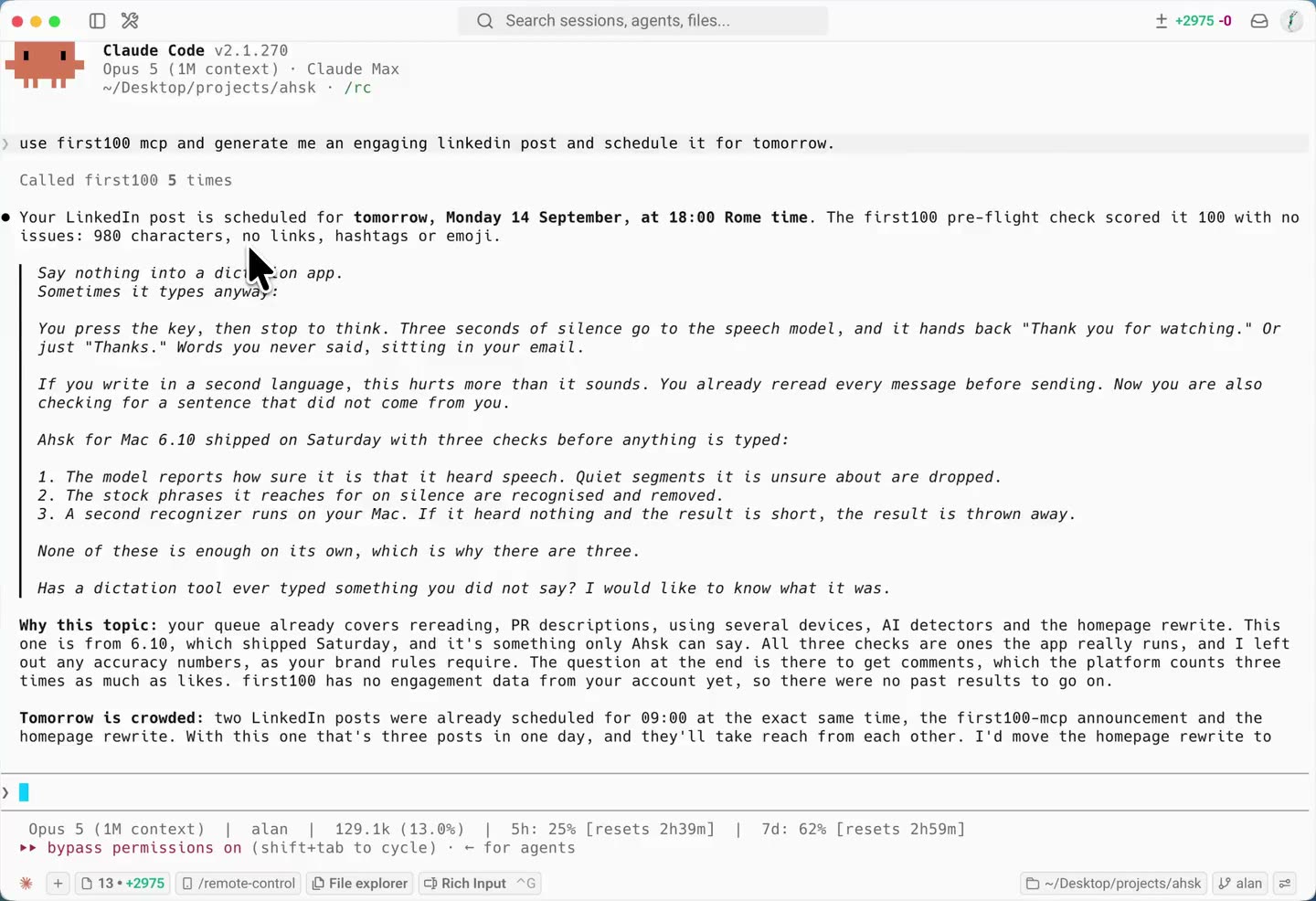
Claude Code wrote the post and First100 scheduled it. The request came from one of my own products, Ahsk.
Why can't a chat agent just publish for me?
Publishing needs three things a model does not carry. It needs a token for your account on each network, granted through that network's OAuth flow. It needs a process that wakes at the scheduled minute even when your session is closed. And it needs to handle the failures: expired tokens, rate limits, an image that is too large for one platform.
None of that is intelligence. It is plumbing, and it breaks in dull ways. X counts a link as 23 characters. Bluesky needs link facets or the link is not clickable. A retry after a timed-out request can post twice. An agent writing the copy should not have to know any of this.
Memory is the second gap. Each new session starts empty. If your brand profile, your last 30 days of posts and your queue live in a tool the agent can call, every session starts from the same facts. Without that, you paste the same context every morning and still get posts that repeat last week.
Measurement is the third. A model cannot see impressions or clicks unless something fetched and stored them. Your own numbers only become advice once a tool has collected enough posts to compare.
Agent writes, tools act: how does MCP connect them?
The Model Context Protocol is the standard that lets an agent call outside tools. The official MCP introduction calls it "an open-source standard for connecting AI applications to external systems" and compares it to "a USB-C port for AI applications". The same page lists Claude, ChatGPT, Visual Studio Code and Cursor among the clients that support it. One server works in all of them.
That gives a clean split of responsibilities:
- The agent writes. It drafts posts, picks angles, reads research and explains numbers in plain language.
- The tool stores. It keeps the brand profile, the product changelog, competitors and past posts.
- The tool acts. It holds the OAuth tokens, schedules posts, publishes them and retries transient failures.
- The tool measures. It pulls post metrics, counts tracked-link clicks and reads Search Console.
- The human decides. You approve the plan, and you post every reply yourself.
First100 is built on that split. It is an MCP server at https://firsthundred.app/api/mcp with more than 40 tools. It has no text generation inside the server; the agent writes every word. First100 publishes and schedules on X, LinkedIn, Threads and Bluesky, stores the brand, reads Search Console and reports what worked. The agent guide lists the capabilities and the setup for each client.
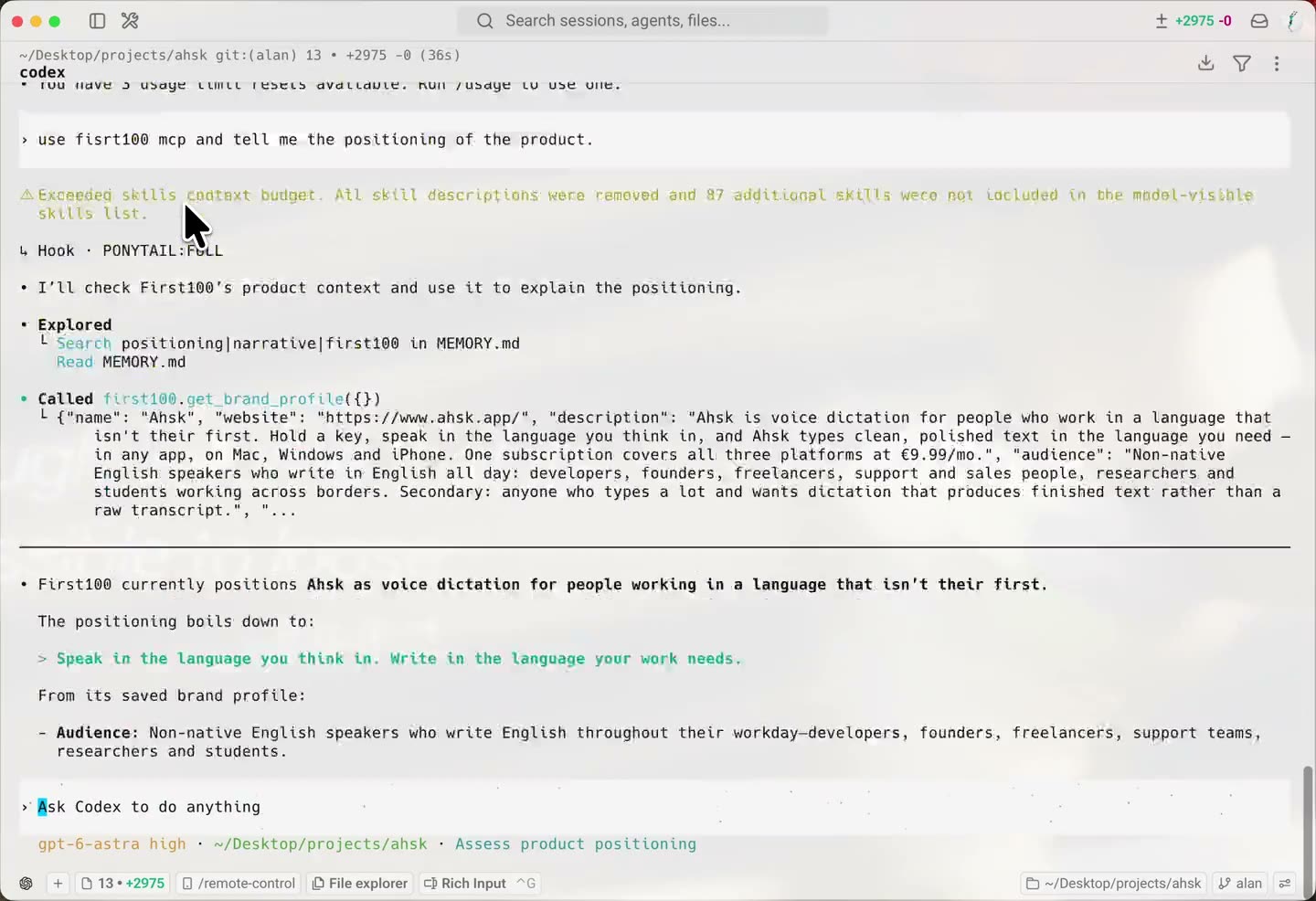
Codex reading a stored brand profile over MCP. The same profile answers every client.
Does guidance from the tool make the agent write better?
Partly, and it depends on the model. On 2026-09-24 we ran a benchmark with Claude Code subagents on 10 real tasks for two brands: eight single posts and two five-post plans. Two writer models, Sonnet 5 and Opus 5, each wrote in three arms. The arms were plain Claude Code, First100's earlier prompt, and the prompt plus our content method. Blind Opus judges scored every draft, in two label orders, against brand facts that included the brand's own published and queued posts.
The content method is data the server returns: thinking steps, 12 angles, 14 psychological levers with when each is honest, and razors to attack a draft with. The agent still writes; the method tells it how to think first.
| Writer | Arm | Overall score /10 | Invented claims |
|---|---|---|---|
| Sonnet 5 | Plain agent | 4.5 | 19 |
| Sonnet 5 | Earlier prompt | 6.3 | 16 |
| Sonnet 5 | Prompt + method | 6.5 | 6 |
| Opus 5 | Plain agent | 6.7 | 25 |
| Opus 5 | Earlier prompt | 7.0 | 2 |
| Opus 5 | Prompt + method | 6.7 | 5 |
The honest reading: guidance lifted the mid-tier writer by about 2 points out of 10. It cut invented claims by 3x to 10x on both models. On the top model, writing quality stayed flat.
The limits matter. We ran one run per arm. Judge noise between rounds was about 0.3 points, so the gap between 6.3 and 6.5 is inside the noise. The judges were models too. Treat this as a direction, not a measured law. The larger effect was on invented claims, and that is the one that gets a founder in trouble.
How do you stop a marketing agent from inventing facts?
Give it facts to lean on, and check every draft against them before it goes out. In our benchmark the plain agents invented the most claims because nothing told them what was true. The fix is boring: a stored profile, a dated log of what shipped, and a check before each post is saved. Here is the routine that worked for us.
- Keep the brand profile current. Audience, tone, pillars, banned topics and links live in one place the agent reads before writing. First100 warns the agent when the profile is older than 30 days.
- Log every change as it happens. When you ship a feature or change a price, tell the agent. It calls log_update, which keeps a dated entry. The next plan leads with the newest updates instead of guessing.
- Separate findings from copy. Account numbers are for choosing angles and times. They should never appear in a post as a boast. The content method marks them that way.
- Run a pre-flight check on each draft. review_post is deterministic: it flags weak hooks, links LinkedIn penalises, filler and engagement bait. It does not judge truth, so you still read the draft.
- Read before you approve. Auto-publish is on by default in First100. If you want a gate, switch it off and drafts wait for your approval.
None of these steps needs a better model. They need a place to keep facts between sessions, which is the gap from the table above.
Where should a marketing agent never act alone?
An agent should never reply, like, follow or send DMs on its own. The platforms say so directly, and account restrictions are the price of ignoring them. The safe pattern is surface and draft: the tool finds the conversation, the agent drafts a reply, and you post it from your own account after reading the thread.
X's automation rules are specific. "Sending automated replies to posts based on keyword searches alone is not permitted." "You may not like posts or hide replies in an automated manner." And you may not "follow or unfollow X accounts in a bulk, aggressive, or indiscriminate manner." The same page notes that a user following your account is not, on its own, enough intent to receive an automated response.
LinkedIn is stricter. Its policy on prohibited software states it does not permit third-party software that can "automate activity on LinkedIn's website". The quoted user agreement bans bots that "create, comment on, like, share, or re-share posts".
First100 follows that line. reply_radar and the morning brief surface threads worth joining and draft an angle for each. They never post the reply. Scheduled posts do publish on their own, because that is the documented use of each platform's posting API. Engagement does not.
What does a solo founder's agent setup look like in week one?
The first week is mostly about feeding the tool facts, then letting the agent work from them. Connect the accounts first, because nothing can publish or be measured without them. Then give the agent your brand, start small, and read your own numbers before trusting generic advice. First100's setup, as the Your first week guide lays it out:
- Day 1: connect accounts. X, LinkedIn, Threads or Bluesky, plus Google Search Console and your mailbox if you plan outreach.
- Day 1: add First100 to your agent. Paste the endpoint as a connector, or use an API key. The week trial costs $5.
- Day 1: give it your brand. The agent proposes a profile from your website; you correct tone, banned topics, timezone and posting hours.
- Day 2: build a watchlist. Ten to thirty accounts your audience already follows, for the reply radar.
- Day 3: plan five to eight posts. Vary the hooks on purpose so the results have contrast. Approve from a table or the calendar.
- Days 4 to 7: run the morning brief. Yesterday's numbers, conversations worth joining with a drafted reply, and the post for today.
After that, ask what worked. The answer comes from your own settled posts, compared by feature. It needs at least five posts older than 48 hours before it reports anything. Until then, it says so instead of guessing.

Claude Desktop with First100 added as a connector, reading a site before proposing a brand profile.
How does this compare with an enterprise marketing agent platform?
Enterprise platforms sell a new place to work: their own agent, their own interface, their own seat price. The solo-founder approach keeps the agent you already use and adds tools to it. Neither is better in general. They answer different questions: "how does a team of 50 govern agents" against "how does one person ship and market in the same afternoon".
| Question | Enterprise agent platform | Your agent plus MCP tools |
|---|---|---|
| Where do you work? | The vendor's app | Claude Code, Codex, Cursor, ChatGPT |
| Who writes the copy? | The platform's model | Your agent's model |
| Where does brand memory live? | The platform | The MCP server you connect |
| What does it cost? | Usually seats or a sales call | Your agent plan plus the tool plan |
| Switching agents | Stays inside the vendor | Same endpoint in another client |
For First100 the tool plan is a $5 week trial, Starter at $39 a month with two brands, or Pro at $59 a month with five. Your agent subscription is separate. The indie hacker use case page shows how a solo founder uses it from the first post to the first customers.
FAQ
What is the best AI agent for marketing for a solo founder?
The best one is usually the agent you already use daily, such as Claude Code, Codex, Cursor or ChatGPT. It already writes and reasons well. Add MCP tools for the parts it cannot do alone: publishing, brand memory, Search Console and measurement. Switching to a new platform adds another app to learn.
Can an AI agent post to social media automatically?
Yes, through a tool that holds your platform tokens and runs a scheduler. The agent drafts the post and the tool publishes it at the chosen time. Automated replies, likes, follows and DMs are a different matter: X and LinkedIn restrict them, so keep a human on engagement.
Does an AI agent for marketing replace a marketer?
No. It takes over drafting, scheduling and reporting. It does not know your customers better than you do, and our benchmark showed even a top model invents claims without brand facts. You still decide positioning, approve plans and talk to people.
What is MCP in marketing?
MCP, the Model Context Protocol, is an open standard for connecting AI applications to outside systems. In marketing it lets your agent call tools that publish posts, read analytics or store a brand profile. One MCP server works across every client that supports the protocol.
Will an AI agent make up facts about my product?
It can. In our 2026-09-24 benchmark, the plain agent arms produced 19 and 25 invented claims. With brand facts and the content method, the same models produced 6 and 5. Always read a draft before it is scheduled.
Your next step: connect one account and plan five posts
Pick the one network your customers actually read. Connect it, add First100 to the agent you already use, and ask for five posts for next week with deliberately different hooks. Read each draft before it is saved. In a week, ask what worked. The first-week guide has the exact prompts to paste.